On October 11, 1968, he occupied the
lunar
module pilot seat for the eleven-day flight of
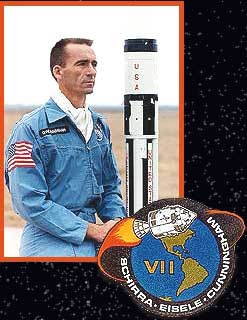
Apollo 7 - the first manned flight test of the third generation United
States spacecraft. With Walter M. Schirra, Jr., and Donn F. Eisele,
Cunningham participated in and executed maneuvers enabling the
crew to perform exercises in transposition
and docking and lunar orbit rendezvous with the
S-IVB
stage of their Saturn IB launch vehicle;
completed eight successful test and maneuvering ignitions of the service module propulsion
engine; measured the accuracy of performance of all spacecraft systems; and provided the first
effective television transmission of onboard crew activities.
The 263-hour, four-and-a-half million mile shakedown flight was
successfully concluded on October 22, 1968, with splashdown occurring in
the Atlantic - some eight miles from the carrier ESSEX (only 3/10 of a mile from the
originally predicted aiming point).
Prior to his assignment to the Apollo 7 crew,
Cunningham was the backup
Lunar
Module Pilot to the crew of Apollo 1. When the Apollo 1 spacecraft burned up on the pad,
killing the entire crew,
Cunningham, Schirra,
and Eisele were assigned to fly the first manned Apollo mission.
Mr. Cunningham's last assignment at the
Johnson Space Center was as Chief of the Skylab Branch of the Fight Crew Directorate. In this
capacity he was responsible for the operational inputs for five major pieces of manned space
hardware, two different boosters and 65 major on-board experiments that comprised the Skylab
program. The Skylab program also utilized the first manned systems employing arrays for
electrical power, molecular sieves for environmental control systems, and inertia storage
devices for attitude control systems.
He worked as a scientist for the RAND Corporation prior to joining NASA. While with RAND,
he worked on classified defense studies and problems of the earth's magnetosphere.
Mr. Cunningham joined the Navy in 1951 and began his flight training in 1952. In 1953 he
became a Marine Corps fighter pilot and served on active duty with the United States Marine
Corps until August 1956 and in the Marine Corps Reserve program until 1975. His present rank
is Colonel, USMCR (Retired).
He has accumulated more than 4,500 hours of flying time, including more than 3,400 in jet
aircraft and 263 hours in space.
Currently, Mr. Cunningham is a successful
businessman, investor and Director of numerous public and private companies. He is author of The
All American Boys, the human side of the space program. He is a radio talk show host and
frequent lecturer throughout the United States, Europe and
Asia. He is a civic leader, is listed in all major Who's Who publications and is a recipient
of numerous national and international honors.
Education:
University of California at Los Angeles (Physics), B.S., 1960, with honors; M.S., 1961,
with distinction.
Institute of Geophysics And Planetary Sciences, completed work on Doctorate in physics with
exception of thesis.
NASA, (Space Sciences and Geology), 2,000 hours, 1963-1971.
Harvard Graduate School of Business 1974. AMP
Organizations:
Associate Fellow of the American Institute
of Aeronautics and Astronautics Fellow of the American Astronautical Society
Member of the Society of Experimental Test
Pilots Member of the American Geophysical Union
Explorers Club
Sigma Pi Sigma and Sigma Xi
Chairman of UCLA Alumni Fund Drive, 1969 and
1970 Aviation Subcommittee, Houston Chamber of
Commerce Advisory Board, The Edward Teller Center For
Science, Technology And Political Thought
Member of the Houston American Revolution
Bicentennial Commission Founding Director, Earth Awareness
Foundation
Special Honors:
Named to the Astronaut Hall of Fame
Awarded the NASA Exceptional Service Medal
and Navy Astronaut Wings Awarded
the NASA Distinguished Service Medal Recipient of the AIAA 1969 Haley
Astronautics Award Presented the UCLA Alumni Professional
Achievement Award for 1969 Academy of Television Arts and Sciences
Special Trustee Award (Emmy) (1969)
American Legion Medal of Valor
Outstanding American Award of the American
Conservative Union, 1975 Named to the International Space Hall of
Fame Houston Hall of Fame
Judge for the 1984 Rolex Awards for
Enterprise Listed in Who's Who in America, Who's Who in
the World, Who's Who in Aviation and other similar publications.
Fellowships:
American Astronautical Society
American Institute of Aeronautics and
Astronautics; Member
Selection Committee for the 1984 Rolex
Awards for Enterprise
Society of Experimental Test Pilots
National Association of Small Business
Investment Companies
Association of Space Explorers
American Geophysical Union
Sigma Pi Sigma
Explorers Club
Numerous other professional and civic
organizations.
Publications:
"Importance of the Observation That Stars
Don't Twinkle Outside the Earth's Atmosphere" (with L. Marshall Libby)
The All American Boys (Macmillan, 1977; Ibooks, 2003), the human side of the space program.
Articles for various magazines, technical
journals and newspapers.
















 Associate Fellow of the American Institute
of Aeronautics and Astronautics
Associate Fellow of the American Institute
of Aeronautics and Astronautics